

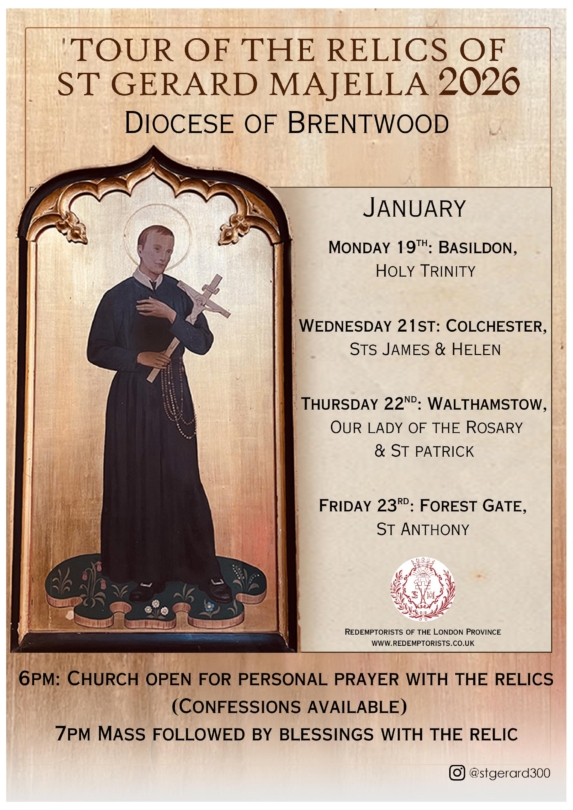
Later this month our diocese will be hosting the relics of St Gerard Majella, patron of expectant mothers and those longing for children, as part of the celebrations of his 300th anniversary. It is a rare opportunity to draw close to the life, witness, and spiritual legacy of one of the most loved saints in the Catholic Church, whose holiness was rooted in humility, compassion, and trust in God.
Brentwood is the first diocese in the Redemptorist tour, which will encompass all of England and Wales.
The relics will be hosted at four locations:
- Holy Trinity, Basildon on Monday 19 January;
- St James the Less and St Helen, Colchester on Wednesday 21 January;
- Our Lady of the Rosary and St Patrick, Walthamstow on Thursday 22 January;
- St Antony of Padua, Forest Gate on Friday 23 January.
The churches will be open for personal prayer in the presence of the relics from 6pm before Mass at 7pm and there will be opportunities for blessings and Confession. Individuals and families are warmly invited to bring their intentions to this popular saint.
The spiritual significance of visiting the relics
Coming into the presence of the relics of St Gerard Majella is an invitation to slow down, to pray, and to reflect on God’s closeness. Many people describe a deep sense of peace, comfort, or renewed faith when praying before relics — not because of any magic, but because such moments open the heart more fully to God.
For some, this may be a time to pray for family members, for healing, for guidance, or simply for strength to carry daily burdens. For others, it may be a quiet moment of gratitude or recommitment to faith.
The Church teaches that God’s grace works through signs — water, oil, bread, wine — and relics form part of this sacramental imagination. They point beyond themselves to Christ, reminding us that God works through real lives and real history.
Who was St Gerard Majella?
St Gerard Majella (1726–1755) was an Italian lay brother of the Redemptorist Order. He lived a short life but one marked by extraordinary holiness in ordinary circumstances. Known for his deep obedience, kindness, and devotion to God, Gerard carried out humble tasks within his religious community while quietly living a life of intense prayer and charity.
He is especially known as the patron saint of expectant mothers, families, and those longing for children, but his appeal extends far beyond this. St Gerard is remembered as a saint who understood human suffering, who listened patiently, and who trusted completely in God’s providence.
His sanctity was not found in grand achievements but in faithfulness to daily duties — a message that resonates powerfully in modern life. His three patronages are: Friend of Workers, Making a Good Confession, The Mother’s Saint.